160 BCE - 120 BCE | AΘΕ / AMΔΙΟ / Ι
Overstriking coin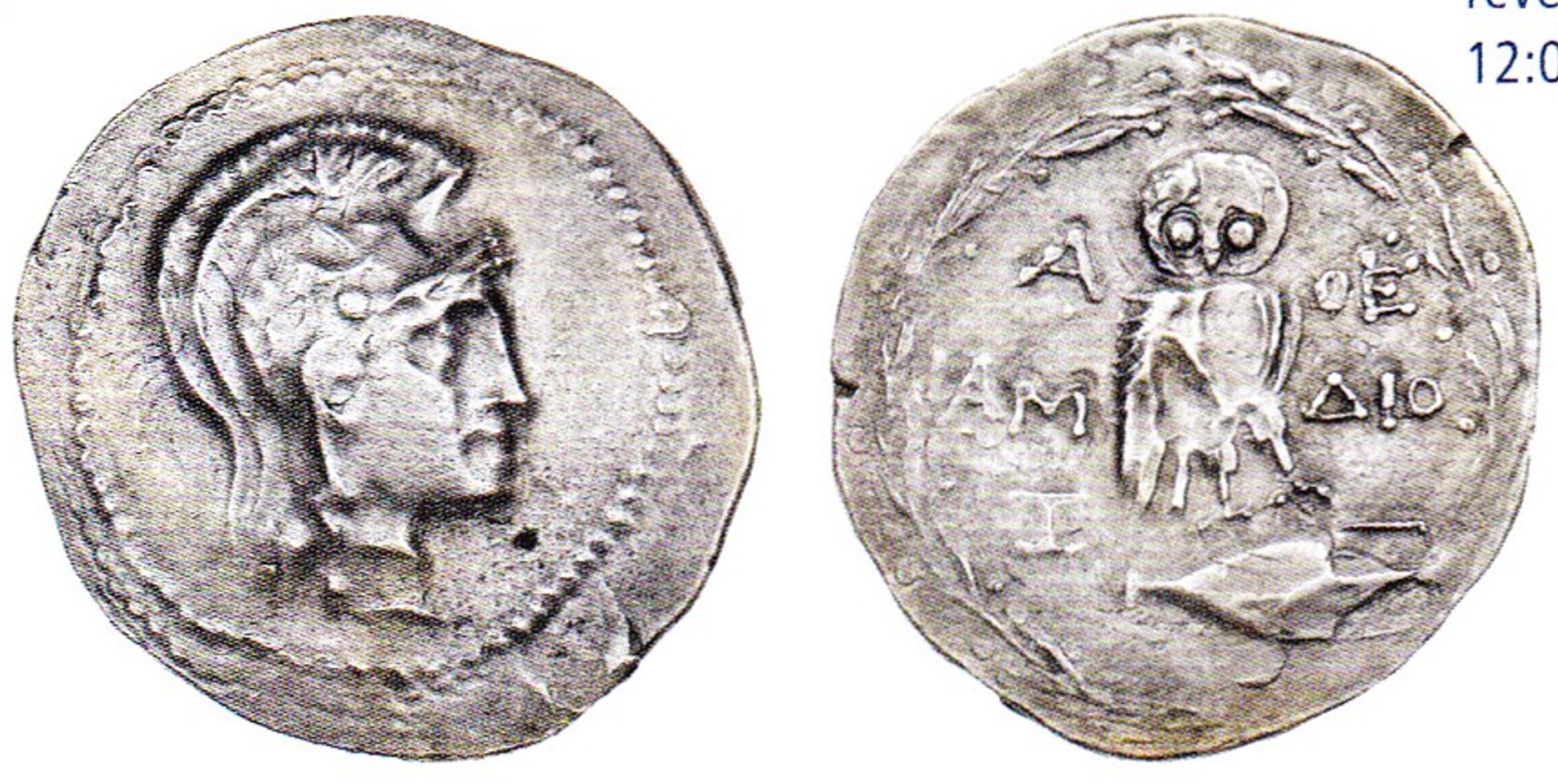
Athenian_imitation_DMD_139.jpg [MacDonald 2009, p. 185-6]
Overstruck variety
Traces of the overstruck variety
Myrina_Apollon_Sack_8_drawing_DMD_139.jpg
Description
| ObverseInscription or printing placed on the obverse.:
|
Head of Athena right, wearing crested Attic helmet. Border of dots.
|
ReverseInscription or printing placed on the reverse.:
|
AΘΕ / AMΔΙΟ / Ι (Greek) Owl perched on amphora. In field, monogram (?). All within laurel wreath.
|
Mint and issuing power
| MintIdentifies the place of manufacture or issue of a numismatic object.:
|
Phoenicia (uncertain Athenian imitation mint)
|
Ancient regionAncient region.
|
Phoenicia
|
Modern countryModern country: Lebanon
|
AuthorityIdentifies the issuing power. The authority can be "pretended" when the name or the portrait of X is on the coin but he/she was not the issuing power. It can also be "uncertain" when there is no mention of X on the coin but he/she was the issuing power according to the historical sources:
|
|
Chronology
| FromIdentifies the initial date in a range assigned in a numismatic context. 160 BCE toIdentifies the final date in a range assigned in a numismatic context.. 120 BCE
|
Hellenistic 323-30 BC  periodTime period of the numismatic object. periodTime period of the numismatic object.
|
Physical description
| MetalThe physical material (usually metal) from which an object is made.: Silver
|
WeightWeight of the numismatic object (in grams). in grams: 16.2516.25 g <br />16,250 mg <br />
|
DenominationTerm indicating the value of a numismatic object. Examples: tetradrachm, chalkous, denarius.: tetradrachm
|
|
|
|
StandardStandard.: Attic
|
References
Description
| ObverseInscription or printing placed on the obverse.:
|
Head of Apollo right, wearing laurel wreath (visible: portion of Apollo's hair, traces of laurel wreath, nose).
|
ReverseInscription or printing placed on the reverse.:
|
MYPINAIΩN (Greek) Apollo Grynios standing right, holding branch with two fillets and phiale. At feet, omphalos and amphora. In field, one or more monograms. All within laurel wreath (visible: traces of wreath, top of Apollo's head, lower edge of garment and feet, branch and fillets).
|
Mint and issuing power
| MintIdentifies the place of manufacture or issue of a numismatic object. ᵖ:
|
Myrina
|
Ancient regionAncient region. ᵖ
|
Aeolis
|
Modern countryModern country: Turkey
|
AuthorityIdentifies the authority in whose name (explicitly or implicitly) a numismatic object was issued. ᵖ:
|
|
Chronology
| FromIdentifies the initial date in a range assigned in a numismatic context. 160 BCE toIdentifies the final date in a range assigned in a numismatic context.. 150 BCE
|
Hellenistic 323-30 BC periodTime period of the numismatic object.
|
Physical description
| DenominationTerm indicating the value of a numismatic object. Examples: tetradrachm, chalkous, denarius. ᵖ:
|
tetradrachm
|
StandardStandard. ᵖ:
|
Attic
|
References
References
- ^ Hoover, Oliver D. (2014), Handbook of Greek Coinage Series 4. Northern and Central Greece : Achaia Phthiotis, Ainis, Magnesia, Malis, Oita, Perrhaibia, Thessaly, Akarnania, Aitolia, Lokris, Phokis, Boiotia, Euboia, Attica, Megaris and Corinthia, sixth to first centuries BC, Lancaster, lxxi, 563 p.
- ^ Thompson, Margaret (1961), The new style silver coinage of Athens, Numismatic Studies 10, New York, 2 vol.
- ^ ΜacDonald 2009
- ^ Sacks, Kenneth S. (1985), "The Wreathed Coins of Aeolian Myrina", American Numismatic Society Museum Notes, 30, p. 1-43, pl. 1-22.

 Traces of the overstruck variety