85 BCE - 70 BCEMAKEΔΟΝΩΝ | AESILLAS Q
Overstriking coin
SO 892 - Thessalonica over Athens.png
Overstruck variety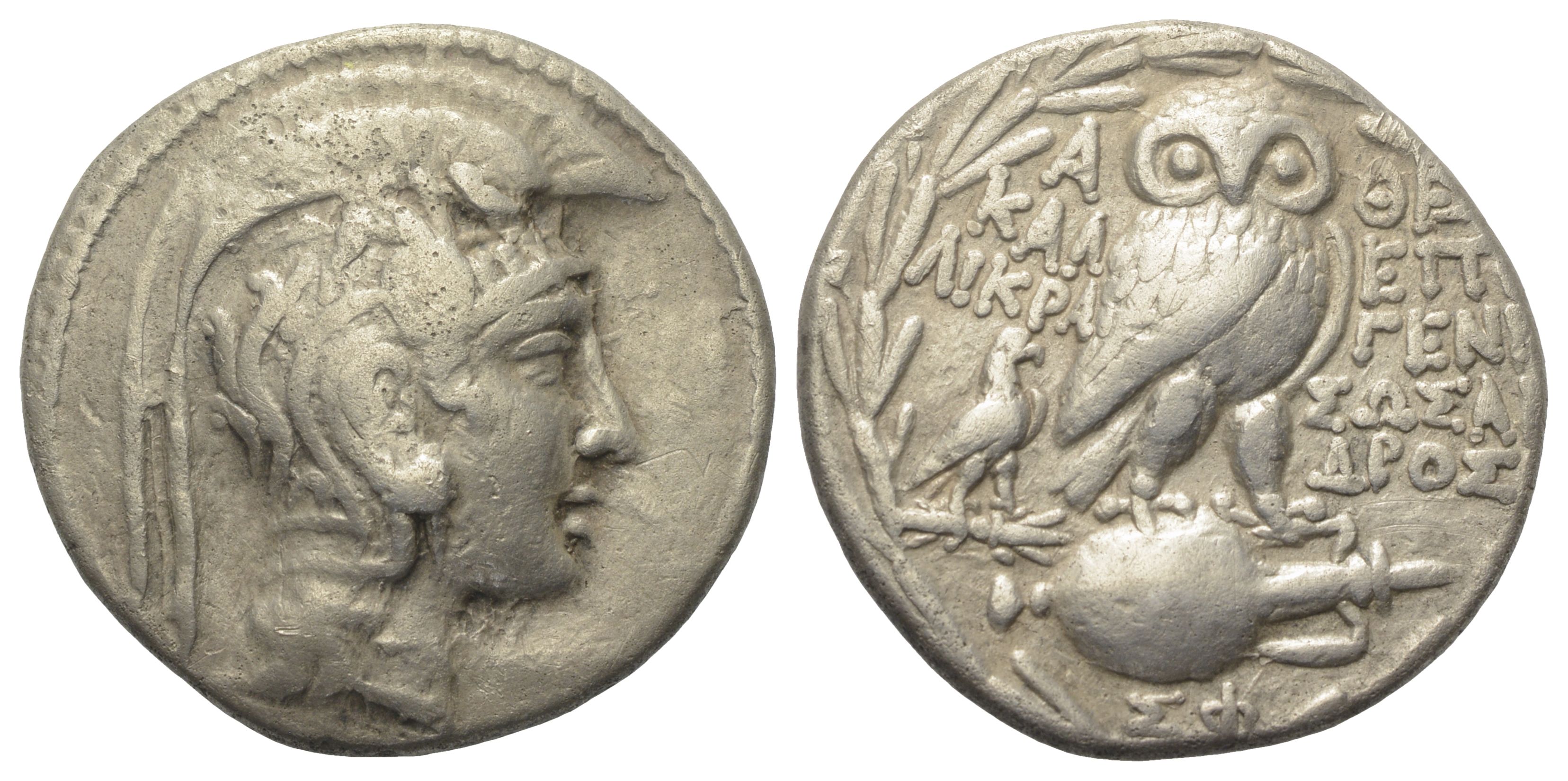
Athens kallikratides.jpg
[1]
| Museum collectionMuseum collection:
|
Berlin, Münzkabinett, Staatliche Museen, 214/1907.
|
|
|
|
|
Description
| ObverseInscription or printing placed on the obverse.:
|
MAKEΔΟΝΩΝ (Greek) Head of Alexander the Great right. Behind head, Θ.
|
ReverseInscription or printing placed on the reverse.:
|
AESILLAS Q (Latin) Fiscus, club and sella curulis. All within laurel wreath.
|
Mint and issuing power
Chronology
| FromIdentifies the initial date in a range assigned in a numismatic context. 85 BCE toIdentifies the final date in a range assigned in a numismatic context.. 70 BCE
|
Hellenistic 323-30 BC  periodTime period of the numismatic object. periodTime period of the numismatic object.
|
Physical description
| MetalThe physical material (usually metal) from which an object is made.: Silver
|
WeightWeight of the numismatic object (in grams). in grams: 16.116.1 g <br />16,100 mg <br />
|
DenominationTerm indicating the value of a numismatic object. Examples: tetradrachm, chalkous, denarius.: tetradrachm
|
|
| DiameterDescribes diameter of an object (in mm).: 3030 mm <br />3 cm <br />
|
StandardStandard.: Attic
|
References
| Coin referenceReference of the Coin:
|
Thompson 1973, p. 56, pl. A, 1.
|
Coin series referenceReference to coin series study:
|
Regling 19081Regling 1908, p. 241, Thompson 19732Thompson 1973, p. 56, pl. A, 1, Bauslaugh 19873Bauslaugh 1987, pl. 3, no. 9, Bauslaugh 20004Bauslaugh 2000, Groups I-III, V-VI and VIII (dies O94-R353), HGC 3.15HGC 3.1, n° 1110, Callataÿ 2021a6Callataÿ 2021a, p. 285, n° 13
|
| Coin series web referenceCoin series web references:
|
|
Description
| ObverseInscription or printing placed on the obverse.:
|
Head of Athena.
|
ReverseInscription or printing placed on the reverse.:
|
A - ΘE / KAΛ / ΛIKPA - EΠI / ΓENH / ΣΩΣAN / ΔPOΣ (Greek) Owl on amphora.
|
Mint and issuing power
| MintIdentifies the place of manufacture or issue of a numismatic object. ᵖ:
|
Athens
|
Ancient regionAncient region. ᵖ
|
Attica
|
Modern countryModern country: Greece
|
AuthorityIdentifies the authority in whose name (explicitly or implicitly) a numismatic object was issued. ᵖ:
|
|
Chronology
| FromIdentifies the initial date in a range assigned in a numismatic context. 125 BCE toIdentifies the final date in a range assigned in a numismatic context.. 124 BCE
|
Hellenistic 323-30 BC periodTime period of the numismatic object.
|
Physical description
| DenominationTerm indicating the value of a numismatic object. Examples: tetradrachm, chalkous, denarius. ᵖ:
|
tetradrachm
|
StandardStandard. ᵖ:
|
Attic
|
References
References
- ^ Regling, Kurt (1908), "Drei Miszellen. I. Aesillas, auf Athen überprägt. II. Kupfernes tetradrachmon. III. Die Tetradrachmen der Kleopatra VII.", Journal International d'Archéologie et de Numismatique 11, p. 241-248 (241-242 for Aesillas).
- ^ Thompson, Margaret (1973), "Byzantium over Aesillas", Revue Numismatique 6 (15), p. 54-65.
- ^ Bauslaugh, Robert A. (1987), "Two unpublished overstrikes: new style Athens and Aesillas the Quaestor," American Numismatic Society. Museum notes 32, p. 11-21
- ^ Bauslaugh, Robert A. (2000), Silver coinage with the types of Aesillas the Quaestor, Numismatic Studies 22, New York.
- ^ Hoover, Oliver D. (2016), Handbook of coins of Macedon and its neighbors. 3. Part I: Macedon, Illyria, and Epeiros, sixth to first centuries BC, Lancaster, 437 p.
- ^ Callataÿ, François de (2021), “On pattern and purpose of overstrikes of late Hellenistic tetradrachms in Thrace Macedonia”, in Ulrike Peter and Bernhard Weisser (eds.), Thrace. Local coinage and regional identity, Berlin Studies of the Ancient World 77, Berlin, Topoi, p. 263-289.
- ^ Thompson, Margaret (1961), The new style silver coinage of Athens, Numismatic Studies 10, New York, 2 vol.
- ^ Hoover, Oliver D. (2014), Handbook of Greek Coinage Series 4. Northern and Central Greece : Achaia Phthiotis, Ainis, Magnesia, Malis, Oita, Perrhaibia, Thessaly, Akarnania, Aitolia, Lokris, Phokis, Boiotia, Euboia, Attica, Megaris and Corinthia, sixth to first centuries BC, Lancaster, lxxi, 563 p.