3325 - Terone (tetradrachm amphora/incuse square) over Acanthus (lion & bull/incuse square) (London, BM, BNK,G.136)
From SILVER
490 BCE - 480 BCET-E
Images
Overstriking coin

SO 744 - Terone over Acanthus.png
Overstruck variety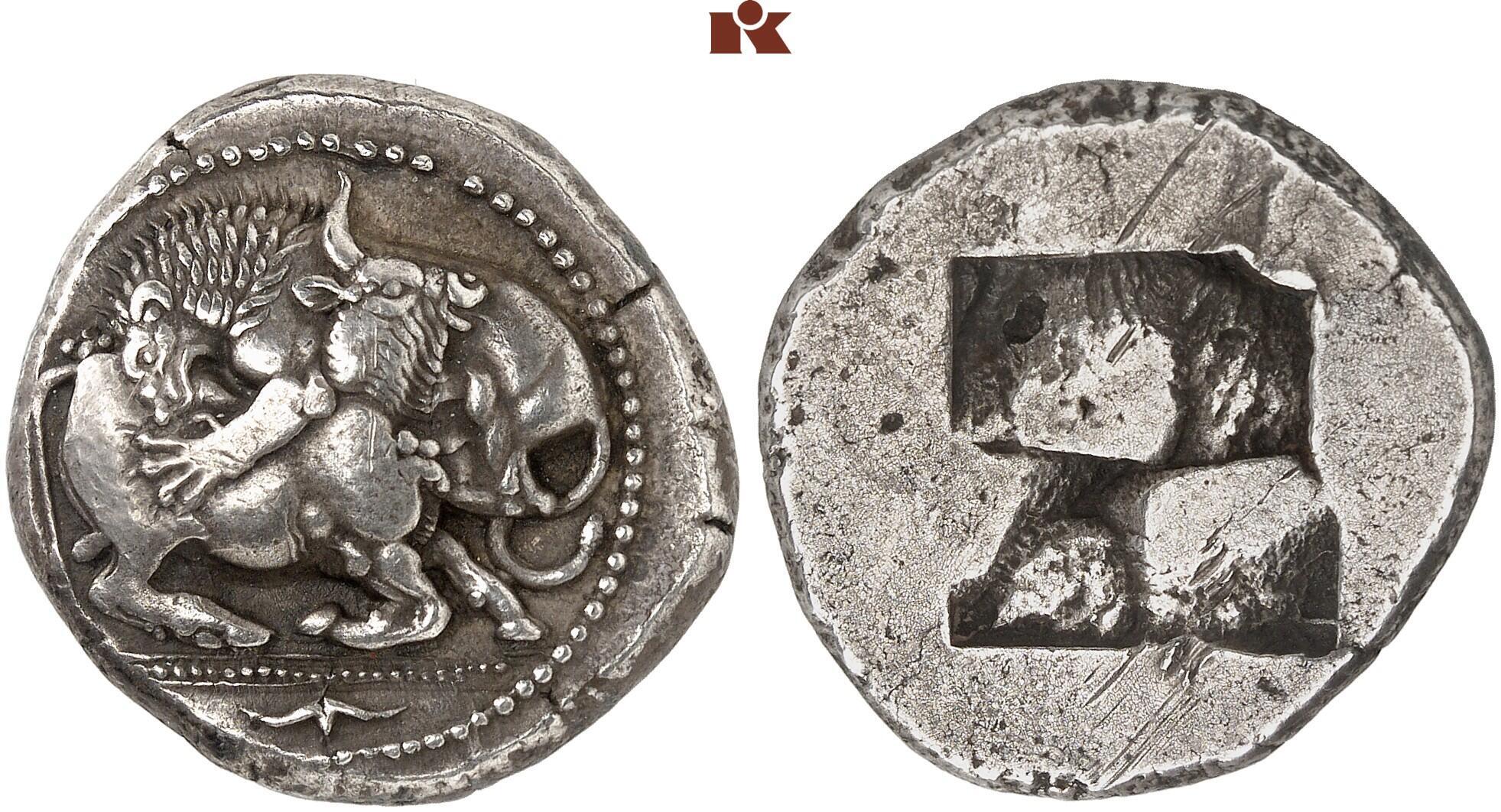
.jpg)
Acanthus (under Sermyle).jpg [1]
Location/history
| Museum collectionMuseum collection: | London, British Museum, BNK, G.136 | |
| Private collection(s)Private collection(s) ᵖ: | Bank of England |
Overstriking coin
Description
| ObverseInscription or printing placed on the obverse.: | T-E (Greek) Amphora with bunches of grapes. Border of dots. | ReverseInscription or printing placed on the reverse.: | Quadripartite incuse square. |
Mint and issuing power
| MintIdentifies the place of manufacture or issue of a numismatic object.: | Terone | Ancient regionAncient region. | Macedon | Modern countryModern country: Greece | AuthorityIdentifies the issuing power. The authority can be "pretended" when the name or the portrait of X is on the coin but he/she was not the issuing power. It can also be "uncertain" when there is no mention of X on the coin but he/she was the issuing power according to the historical sources: |
Chronology
| FromIdentifies the initial date in a range assigned in a numismatic context. 490 BCE toIdentifies the final date in a range assigned in a numismatic context.. 480 BCE | Classical 480-323 BC  periodTime period of the numismatic object. periodTime period of the numismatic object.
|
Physical description
| MetalThe physical material (usually metal) from which an object is made.: Silver
|
WeightWeight of the numismatic object (in grams). in grams: 16.6116.61 g <br />16,610 mg <br /> | DenominationTerm indicating the value of a numismatic object. Examples: tetradrachm, chalkous, denarius.: tetradrachm
|
AxisDescribes the directional relationship between the obverse and reverse of a numismatic object.: 1111 mm <br />1.1 cm <br /> |
| StandardStandard.: Attic-Euboic | |||
References
| Coin referenceReference of the Coin: | Gaebler 1935, 114, n° 2, pl. 22, n° 8, Kraay 1955, 10, n° 4a., Tselekas 2002, p. 30-40, n° A5., BMC, p. 106, n° 1 | Coin series referenceReference to coin series study: | Gaebler 19351Gaebler 1935, 114, n° 2, pl. 22, n° 8, Hardwick 19982Hardwick 1998, n° 5, Tselekas 20023Tselekas 2002, p. 30-40, n° A5, HGC 3.14HGC 3.1, n° 705 |
| Coin series web referenceCoin series web references: | |||
Overstruck type
Description
| ObverseInscription or printing placed on the obverse.: | Lion right clinging with tooth and claw on the hindquarters of a bull kneeling left with head raised and looking forwards. In exergue, floral ornament. Border of dots (visible: left front claw of lion, tail and back of bull, parts of dotted circle). | ReverseInscription or printing placed on the reverse.: | Quadripartite incuse square (visible: traces of outline of square). |
Mint and issuing power
| MintIdentifies the place of manufacture or issue of a numismatic object. ᵖ: | Acanthus | Ancient regionAncient region. ᵖ | Macedon | Modern countryModern country: Greece | AuthorityIdentifies the authority in whose name (explicitly or implicitly) a numismatic object was issued. ᵖ: |
Chronology
| FromIdentifies the initial date in a range assigned in a numismatic context. 525 BCE toIdentifies the final date in a range assigned in a numismatic context.. 480 BCE | Archaic until 480 BC periodTime period of the numismatic object.
|
Physical description
| DenominationTerm indicating the value of a numismatic object. Examples: tetradrachm, chalkous, denarius. ᵖ: | tetradrachm
|
References
| Coin type referenceReference to coin series study ᵖ: | Desneux 19495Desneux 1949, Tselekas 19966Tselekas 1996, HGC 3.27HGC 3.2, n° 381 | ||
| Coin series web reference overstruckCoin series web references overstruck: | |||
Additional data
| Frequency of overstrikesFrequency of overstrikes: | frequent | Level of confidenceLevel of confidence of the identification: | sure |
| RemarksRemarks: | |||
References
- ^ Gaebler, Hugo (1935), Die antiken Münzen Nord-Griechenlands, unter Leitung von Theodor Wiegand. Band III, Makedonia und Paionia. 2. Abt., Verlag W. de Gruyter, Berlin
- ^ Hardwick, Nicholas (1998), "The coinage of Terone from the fifth to the fourth centuries B.C.", in Ashton, Richard and Hurter, Silvia (eds), Studies in Greek numismatics in memory of Martin Jessop Price, Spink, London, p.119-134.
- ^ Tselekas, Panagiotis (2002), "Late archaic overstruck staters in the Chalkidike", Nomismatika Chronika 21, p. 30-40.
- ^ Hoover, Oliver D. (2016), Handbook of coins of Macedon and its neighbors. 3. Part I: Macedon, Illyria, and Epeiros, sixth to first centuries BC, Lancaster, 437 p.
- ^ Desneux, Jules (1949), "Les tétradrachmes d’Akanthos", Revue Belge de Numismatique, 95, p. 5-122, pl. 1-38.
- ^ Tselekas, Panagiotis (1996), The Coinage of Acanthus, Oxford, St Cross College, DPhil, 350 p., 7 maps, 53 pl.
- ^ Hoover, Oliver D. (2017), Handbook of Coins of Macedon and Its Neighbors. 3. Part 2: Thrace, Skythia, and Taurike, Sixth to First Centuries BC, Lancaster-London, xix, 232 p.