323 BCE - 319 BCE | AΛEΞANΔPOY
Overstriking coin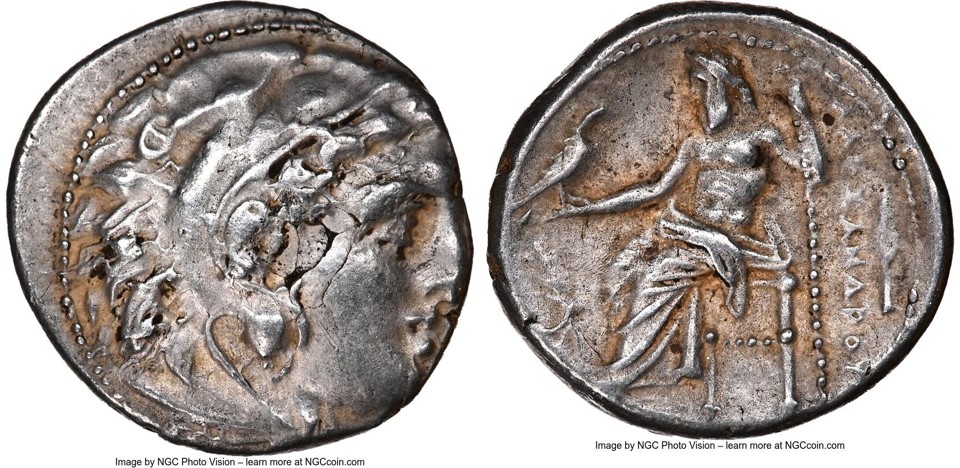
Alexander_III_Heritage,_232223,_8_June_2022,_62044.jpg
[1]
|
|
Sale(s)Sale(s) ᵖ:
|
Heritage, 232223, 8 June 2022, 62044
|
|
|
|
Description
| ObverseInscription or printing placed on the obverse.:
|
Head of Herakles right, wearing lion skin
|
ReverseInscription or printing placed on the reverse.:
|
AΛEΞANΔPOY (Greek) Zeus seated left on backless throne, right leg drawn back, feet on stool, eagle in right hand, scepter in left, filleted branch in left field, spear head upward in outer right field
|
Mint and issuing power
Chronology
| FromIdentifies the initial date in a range assigned in a numismatic context. 323 BCE toIdentifies the final date in a range assigned in a numismatic context.. 319 BCE
|
Hellenistic 323-30 BC  periodTime period of the numismatic object. periodTime period of the numismatic object.
|
Physical description
| MetalThe physical material (usually metal) from which an object is made.: Silver
|
|
DenominationTerm indicating the value of a numismatic object. Examples: tetradrachm, chalkous, denarius.: drachma
|
AxisDescribes the directional relationship between the obverse and reverse of a numismatic object.: 1111 mm <br />1.1 cm <br />
|
| DiameterDescribes diameter of an object (in mm).: 1717 mm <br />1.7 cm <br />
|
StandardStandard.: Attic
|
References
Description
| ObverseInscription or printing placed on the obverse.:
|
|
ReverseInscription or printing placed on the reverse.:
|
|
Mint and issuing power
| MintIdentifies the place of manufacture or issue of a numismatic object. ᵖ:
|
|
Ancient regionAncient region. ᵖ
|
|
Modern countryModern country:
|
AuthorityIdentifies the authority in whose name (explicitly or implicitly) a numismatic object was issued. ᵖ:
|
|
Chronology
| FromIdentifies the initial date in a range assigned in a numismatic context. toIdentifies the final date in a range assigned in a numismatic context..
|
periodTime period of the numismatic object.
|
Physical description
References
References
- ^ Price, Martin Jessop (1991), The Coinage in the Name of Alexander the Great and Philip Arrhidaeus: a British Museum Catalogue, 2 vol., Zürich-London, 637 p., 637 p., clix pl.