"[[Coin series reference" contains a listed "[" character as part of the property label and has therefore been classified as invalid.]]1Babelon 1901-1932, Tome 1, Part 2, p. 526-530, n° 869-70, "[[Coin series reference" contains a listed "[" character as part of the property label and has therefore been classified as invalid.]]2SNG von Aulock Pamphylien, n° 4482-83, "[[Coin series reference" contains a listed "[" character as part of the property label and has therefore been classified as invalid.]]3SNG France 3, n° 12-13, "[[Coin series reference" contains a listed "[" character as part of the property label and has therefore been classified as invalid.]]4Callataÿ 2000b, "[[Coin series reference" contains a listed "[" character as part of the property label and has therefore been classified as invalid.]]5Callataÿ 2018b, "[[Coin series reference" contains a listed "[" character as part of the property label and has therefore been classified as invalid.]]6Callataÿ 2022
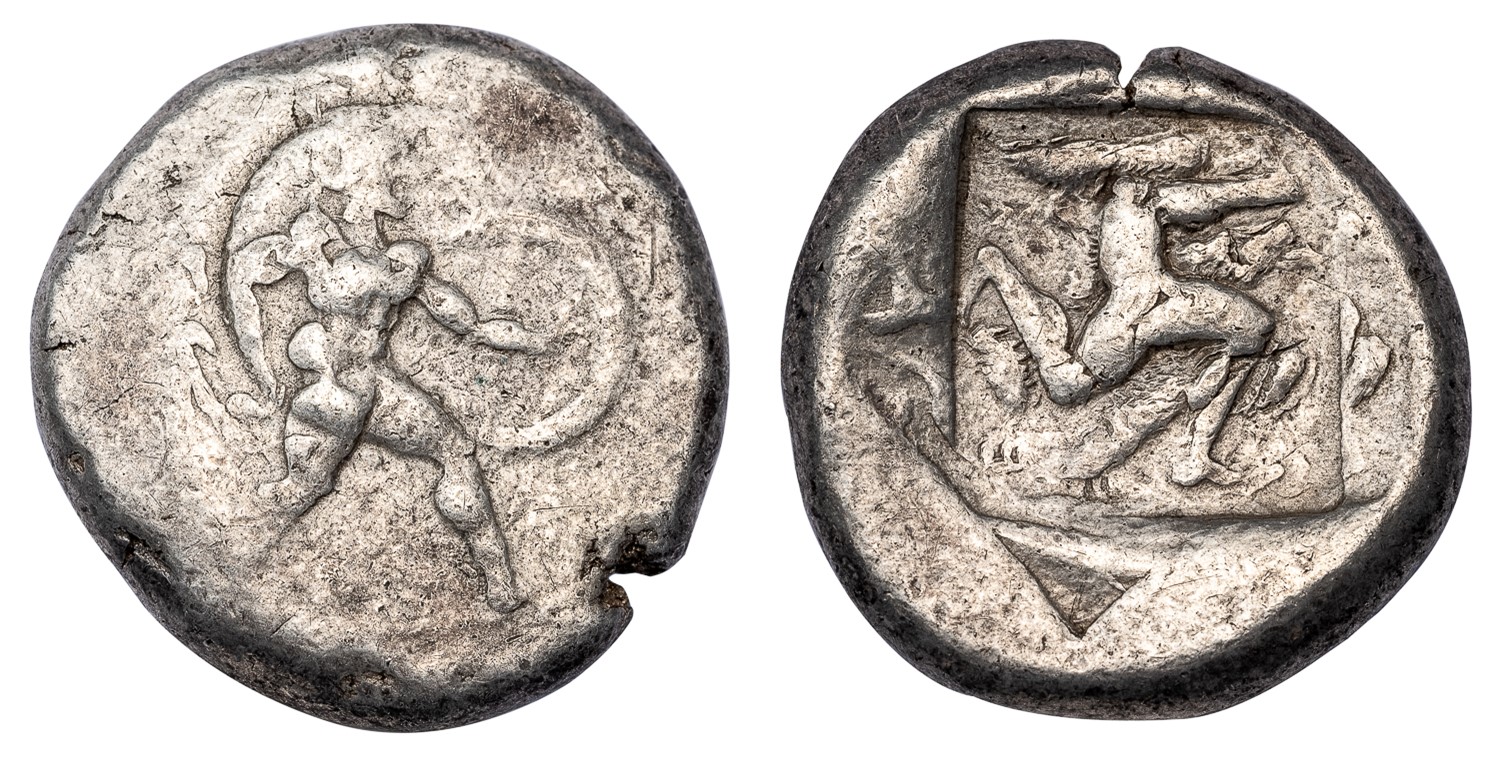
"overstruck at least once over a coin with a flying eagle right (cf. a Lyttus, Crete specimen in Le Rider, Crétoises, p. 101, no. 5, pl. XXV, 15) and likely another, earlier coin, whose incuse square appears rotated some 15 degrees relative to the other two (Aspendus and Lyttus) that overlap. Since Cretan coins were often overstruck on other issues from the island, this multiple overstrike could be as follows: Aspendus over Lyttus over another Cretan piece" (nb: it cannot be Lyttus since the round shape on the obverse cannot be reconciled with the boar type it would have; as th identification of the undertype looks problematic - the coin has also been double struck - it is safer to leave it as "uncertain")
References
^Babelon, Ernest (1901-1932), Traité des monnaies grecques et romaines, Paris, E. Leroux
^Levante, Edoardo [with the collaboration of Peter Weiss] (2001), Sylloge nummorum graecorum. France. 3, Département des monnaies, médailles et antiques : Pamphylie, Pisidie, Lyaconie, Galatie, Paris-Zürich, Bibliothèque nationale de France-Numismatica Ars Classica, XXXIV + 293 p. and 146 pl.
^Callataÿ, François de (2000), "Les monnayages ciliciens du premier quart du IVe s. av. J.-C.", dans O. Casabonne (éd.), Mécanismes et innovations monétaires dans l'Anatolie achéménide, Numismatique et histoire. Actes de la Table Ronde Internationale d'Istanbul, 22-23 mai 1997, Paris, p. 93-127, pl IX-XV.
^Callataÿ, François de (2018), “Overstrikes on Pamphylian and Cilician silver sigloi (5th-4th c. BC)”, in O. Tekin (ed.), Proceedings of the Second International Congress of the Anatolian Monetary History and Numismatics in the Mediterranean World, 5-8 January 2017 Antalya, Antalya, 2018, p. 131-150.
^Callataÿ, François de (2022), “Pseudo-Civic not Civic: The Abundant Double Sigloi Struck by Pamphylian and Cilician Cities (ca 460–333 B.C.E.),” Phoenix, 76 (A. Meadows and J. Bodzek [eds.], Coinage in Imperial Space: Coins in the Economy of the Achaemenid and Early Hellenistic World), p. 45-69.

 period


