2780 - Sardinia (uncertain Punic mint) (AE Tanit/standing horse & palm tree) over uncertain type (Pegasi, 27, Nov. 2012, 286)
From SILVER
263 BCE - 242 BCE
Images
Overstriking coin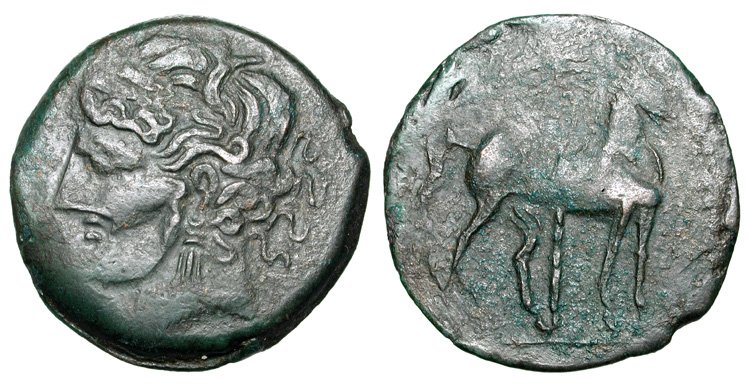

Carthage_over_uncertain_mint_Pegasi_286.jpg [1]
Location/history
| Sale(s)Sale(s) ᵖ: | Pegasi, 27, 6 Nov. 2012, 286 | |
Overstriking coin
Description
| ObverseInscription or printing placed on the obverse.: | Head of Tanit left, wearing necklace, earrings and wreath. Border of dots. | ReverseInscription or printing placed on the reverse.: | Horse right. In background, palm tree? |
Mint and issuing power
| MintIdentifies the place of manufacture or issue of a numismatic object.: | Sardinia (uncertain Punic mint) | Ancient regionAncient region. | Sardinia | Modern countryModern country: Italy | AuthorityIdentifies the issuing power. The authority can be "pretended" when the name or the portrait of X is on the coin but he/she was not the issuing power. It can also be "uncertain" when there is no mention of X on the coin but he/she was the issuing power according to the historical sources: | Carthaginian Empire |
Chronology
| FromIdentifies the initial date in a range assigned in a numismatic context. 263 BCE toIdentifies the final date in a range assigned in a numismatic context.. 242 BCE | Hellenistic 323-30 BC  periodTime period of the numismatic object. periodTime period of the numismatic object.
|
Physical description
| MetalThe physical material (usually metal) from which an object is made.: Bronze
|
WeightWeight of the numismatic object (in grams). in grams: 13.8213.82 g <br />13,820 mg <br /> | DenominationTerm indicating the value of a numismatic object. Examples: tetradrachm, chalkous, denarius.: 2 shekels
|
|
| DiameterDescribes diameter of an object (in mm).: 2929 mm <br />2.9 cm <br /> | |||
References
| Coin referenceReference of the Coin: | Babelon 1936, n° 3798, SNG Copenhagen North Africa, n° 219, Alexandropoulos 2007, n° 45. | Coin series referenceReference to coin series study: | Babelon 19361Babelon 1936, n° 3798, SNG Copenhagen North Africa2SNG Copenhagen North Africa, n° 219, Alexandropoulos 20073Alexandropoulos 2007, n° 45. |
| Coin series web referenceCoin series web references: | |||
Overstruck type
Description
| ObverseInscription or printing placed on the obverse.: | ReverseInscription or printing placed on the reverse.: |
Mint and issuing power
| MintIdentifies the place of manufacture or issue of a numismatic object. ᵖ: | Ancient regionAncient region. ᵖ | Modern countryModern country: | AuthorityIdentifies the authority in whose name (explicitly or implicitly) a numismatic object was issued. ᵖ: |
Chronology
| FromIdentifies the initial date in a range assigned in a numismatic context. toIdentifies the final date in a range assigned in a numismatic context.. | periodTime period of the numismatic object. |
Physical description
References
| Coin type referenceReference to coin series study ᵖ: |
Additional data
| Frequency of overstrikesFrequency of overstrikes: | frequent | Level of confidenceLevel of confidence of the identification: | |
| RemarksRemarks: | "Overstruck" | ||
References
- ^ Babelon, Jean (1936), Catalogue de la collection de Luynes, Monnaies grecques. IV, Syrie, Égypte, Cyrénaïque, Maurétanie, Zeugitane, Numidie, Jules Florange : Louis Ciani, Paris
- ^ Jenkins, Gilbert Kenneth (1992), Sylloge Nummorum Graecorum: Royal Collection of Coins and Medals. Danish National Museum, volume 8. Egypt, North Africa, Spain, Gaul. Sunrise Publ., Inc.
- ^ Alexandropoulos, Jacques (2007), Les monnaies de l'Afrique antique (400 av. J.-C.-40 ap. J.-C.), Presses universitaires du Mirail, Toulouse, 507 p., 17 pl.