400 BCE - 380 BCE'pa-si-le-wo-se sa-ta-si-o-i-ko' in Cypriot syllabic script | 'pa-si-le-wo-se sa-ta-si-o-i-ko' in Cypriot syllabic script
Overstriking coin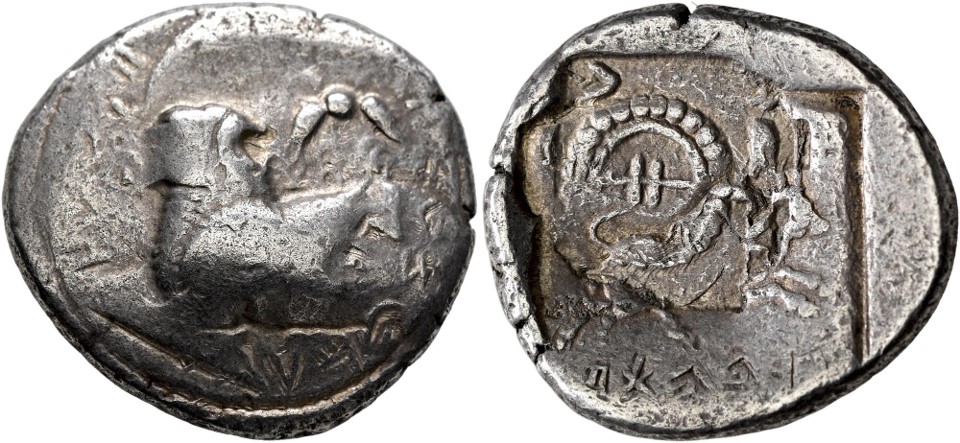
Marium_Leu_Numismatik,_EA_32,_7_Dec._2024,_726.jpg
[1]
|
|
Sale(s)Sale(s) ᵖ:
|
Leu Numismatik, EA 32, 7 Dec. 2024, 726
|
|
|
|
Description
| ObverseInscription or printing placed on the obverse.:
|
'pa-si-le-wo-se sa-ta-si-o-i-ko' in Cypriot syllabic script (Cypriot) Laureate head of Apollo to right
|
ReverseInscription or printing placed on the reverse.:
|
'pa-si-le-wo-se sa-ta-si-o-i-ko' in Cypriot syllabic script (Cypriot) Aphrodite (or Europa) hanging beside bull running right, grasping the bull's right horn with her right hand, all within incuse square
|
Mint and issuing power
Chronology
| FromIdentifies the initial date in a range assigned in a numismatic context. 400 BCE toIdentifies the final date in a range assigned in a numismatic context.. 380 BCE
|
Classical 480-323 BC  periodTime period of the numismatic object. periodTime period of the numismatic object.
|
Physical description
| MetalThe physical material (usually metal) from which an object is made.: Silver
|
WeightWeight of the numismatic object (in grams). in grams: 10.9510.95 g <br />10,950 mg <br />
|
DenominationTerm indicating the value of a numismatic object. Examples: tetradrachm, chalkous, denarius.: double siglos
|
AxisDescribes the directional relationship between the obverse and reverse of a numismatic object.: 1212 mm <br />1.2 cm <br />
|
| DiameterDescribes diameter of an object (in mm).: 2525 mm <br />2.5 cm <br />
|
StandardStandard.: Persian
|
References
Description
| ObverseInscription or printing placed on the obverse.:
|
Recumbent ram to left
|
ReverseInscription or printing placed on the reverse.:
|
Ankh within incuse square
|
Mint and issuing power
| MintIdentifies the place of manufacture or issue of a numismatic object. ᵖ:
|
Salamis
|
Ancient regionAncient region. ᵖ
|
Cyprus
|
Modern countryModern country: Turkey
|
AuthorityIdentifies the authority in whose name (explicitly or implicitly) a numismatic object was issued. ᵖ:
|
|
Chronology
| FromIdentifies the initial date in a range assigned in a numismatic context. 520 BCE toIdentifies the final date in a range assigned in a numismatic context.. 460 BCE
|
Archaic until 480 BC periodTime period of the numismatic object.
|
Physical description
| DenominationTerm indicating the value of a numismatic object. Examples: tetradrachm, chalkous, denarius. ᵖ:
|
double siglos
|
StandardStandard. ᵖ:
|
Persian
|
References
References
- ^ Hill, George Francis (1904), A Catalogue of the Greek coins in the British Museum, vol XX : Cyprus, London, cxliv, 119 p., xxvi pl.,
- a b Tziambazis, Elias (2002), A catalogue of the coins of Cyprus: from 560 B.C. to 1571 A.D., Larnaca, 89 p.