24821 - Etenna (AE nymph/knife) over uncertain type (Gorny & Mosch, EA 295, March 2023, 2203)
From SILVER
100 BCE - 30 BCE | ET
Images
Overstriking coin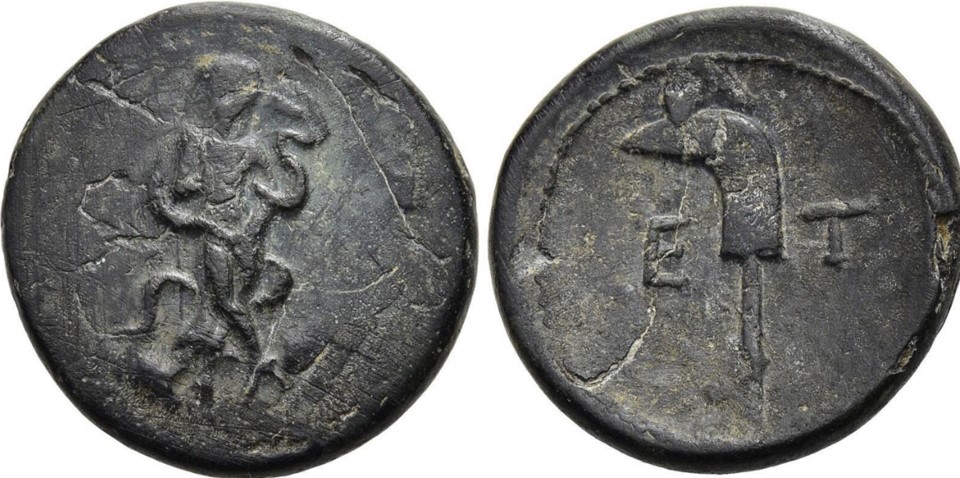

Etenna_Gorny_&_Mosch,_EA_295,_22_March_2023,_2203.jpg [1]
Location/history
| Sale(s)Sale(s) ᵖ: | Gorny & Mosch, EA 295, 22 March 2023, 2203. | |
Overstriking coin
Description
| ObverseInscription or printing placed on the obverse.: | Nymph facing, with serpent wrapped around her. Behind, overturned oinochoe. | ReverseInscription or printing placed on the reverse.: | ET (Greek) Sickle-shaped knife. |
Mint and issuing power
| MintIdentifies the place of manufacture or issue of a numismatic object.: | Etenna | Ancient regionAncient region. | Pisidia | Modern countryModern country: Turkey | AuthorityIdentifies the issuing power. The authority can be "pretended" when the name or the portrait of X is on the coin but he/she was not the issuing power. It can also be "uncertain" when there is no mention of X on the coin but he/she was the issuing power according to the historical sources: |
Chronology
| FromIdentifies the initial date in a range assigned in a numismatic context. 100 BCE toIdentifies the final date in a range assigned in a numismatic context.. 30 BCE | Hellenistic 323-30 BC  periodTime period of the numismatic object. periodTime period of the numismatic object.
|
Physical description
| MetalThe physical material (usually metal) from which an object is made.: Bronze
|
WeightWeight of the numismatic object (in grams). in grams: 3.733.73 g <br />3,730 mg <br /> | ||
| DiameterDescribes diameter of an object (in mm).: 1818 mm <br />1.8 cm <br /> | |||
References
| Coin referenceReference of the Coin: | Coin series referenceReference to coin series study: | SNG Copenhagen Pisidia1SNG Copenhagen Pisidia, n° 146, SNG von Aulock Pisidien2SNG von Aulock Pisidien, n° 5018, SNG France 33SNG France 3, n° 1538-1540 | |
| Coin series web referenceCoin series web references: | |||
Overstruck type
Description
| ObverseInscription or printing placed on the obverse.: | ReverseInscription or printing placed on the reverse.: |
Mint and issuing power
| MintIdentifies the place of manufacture or issue of a numismatic object. ᵖ: | Ancient regionAncient region. ᵖ | Modern countryModern country: | AuthorityIdentifies the authority in whose name (explicitly or implicitly) a numismatic object was issued. ᵖ: |
Chronology
| FromIdentifies the initial date in a range assigned in a numismatic context. toIdentifies the final date in a range assigned in a numismatic context.. | periodTime period of the numismatic object. |
Physical description
References
| Coin type referenceReference to coin series study ᵖ: |
Additional data
| Frequency of overstrikesFrequency of overstrikes: | Level of confidenceLevel of confidence of the identification: | ||
| RemarksRemarks: | |||
References
- ^ Breitenstein, Niels (1956), Sylloge Nummorum Graecorum: Royal Collections of coins and medals. Danish National Museum, 32, Pisidia.
- ^ Sylloge Nummorum Graecorum. Sammlung v. Aulock. Pisidien - Lykaonien - Isaurien. 12 Heft (n° 4894-5412), Berlin, 1964.
- ^ Levante, Edoardo [with the collaboration of Peter Weiss] (2001), Sylloge nummorum graecorum. France. 3, Département des monnaies, médailles et antiques : Pamphylie, Pisidie, Lyaconie, Galatie, Paris-Zürich, Bibliothèque nationale de France-Numismatica Ars Classica, XXXIV + 293 p. and 146 pl.