480 BCE - 460 BCEu-si-se-o (in Cypriot) below | pa (in Cypriot); se-si-[le]-o (in Cypriot) counterclockwise around from upper right
Overstriking coin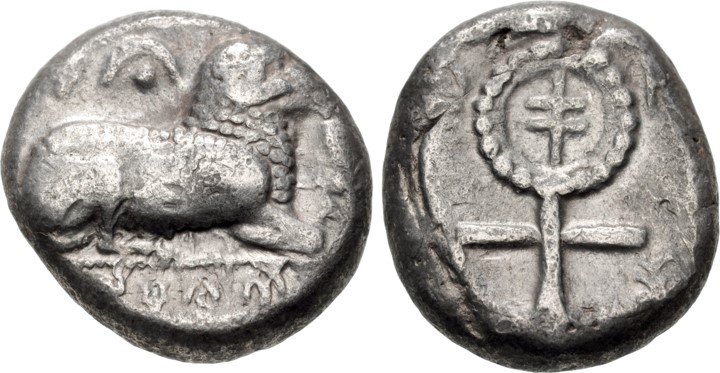
Salamis_over_Aegina_Classical_Numismatic_Group,_123,_23_May_2023,_206.jpg
[1]
|
|
Sale(s)Sale(s) ᵖ:
|
Classical Numismatic Group, 123, 23 May 2023, 206
|
|
|
|
Description
| ObverseInscription or printing placed on the obverse.:
|
u-si-se-o (in Cypriot) below (Cypriot) Ram couchant right pellet-in-crescent and pa (in Cypriot) above
|
ReverseInscription or printing placed on the reverse.:
|
pa (in Cypriot); se-si-[le]-o (in Cypriot) counterclockwise around from upper right (Cypriot) Large ornate ankh within incuse square
|
Mint and issuing power
| MintIdentifies the place of manufacture or issue of a numismatic object.:
|
Salamis
|
Ancient regionAncient region.
|
Cyprus
|
Modern countryModern country: Turkey
|
AuthorityIdentifies the issuing power. The authority can be "pretended" when the name or the portrait of X is on the coin but he/she was not the issuing power. It can also be "uncertain" when there is no mention of X on the coin but he/she was the issuing power according to the historical sources:
|
|
Chronology
| FromIdentifies the initial date in a range assigned in a numismatic context. 480 BCE toIdentifies the final date in a range assigned in a numismatic context.. 460 BCE
|
Classical 480-323 BC  periodTime period of the numismatic object. periodTime period of the numismatic object.
|
Physical description
| MetalThe physical material (usually metal) from which an object is made.: Silver
|
WeightWeight of the numismatic object (in grams). in grams: 10.9610.96 g <br />10,960 mg <br />
|
DenominationTerm indicating the value of a numismatic object. Examples: tetradrachm, chalkous, denarius.: double siglos
|
AxisDescribes the directional relationship between the obverse and reverse of a numismatic object.: 22 mm <br />0.2 cm <br />
|
| DiameterDescribes diameter of an object (in mm).: 20.520.5 mm <br />2.05 cm <br />
|
StandardStandard.: Persian
|
References
Description
| ObverseInscription or printing placed on the obverse.:
|
Turtle
|
ReverseInscription or printing placed on the reverse.:
|
Skew pattern incuse square
|
Mint and issuing power
| MintIdentifies the place of manufacture or issue of a numismatic object. ᵖ:
|
Aegina
|
Ancient regionAncient region. ᵖ
|
Attica
|
Modern countryModern country: Greece
|
AuthorityIdentifies the authority in whose name (explicitly or implicitly) a numismatic object was issued. ᵖ:
|
|
Chronology
| FromIdentifies the initial date in a range assigned in a numismatic context. 480 BCE toIdentifies the final date in a range assigned in a numismatic context.. 457 BCE
|
Classical 480-323 BC periodTime period of the numismatic object.
|
Physical description
| DenominationTerm indicating the value of a numismatic object. Examples: tetradrachm, chalkous, denarius. ᵖ:
|
stater
|
StandardStandard. ᵖ:
|
Aeginetic
|
References
References
- ^ McGregor, Kaelyn Ann (1999), The Coinage of Salamis, Cyprus, from the Sixth to the Fourth Centuries, University College London, unpublished PhD Thesis, London, 2 vol.
- ^ Hoover, Oliver D. (2010), The Handbook of Greek Coinage Series, volume 6 : handbook of coins of the islands: Adriatic, Iionian, Thracian, Aegean, and Carpathian seas (excluding Crete and Cyprus), sixth to first centuries BC, Lancaster, 358 p.
- ^ Meadows, Andrew (forthcoming), Greek coinage in the Persian Empire: The Malayer 1934 Hoard (IGCH 1790).