1749 - Metapontum (nomos ear of barley/ear of barley) over uncertain type (UBS, 59, Jan. 2004, 5166)
From SILVER
470 BCE - 440 BCEMETA
Images
Overstriking coin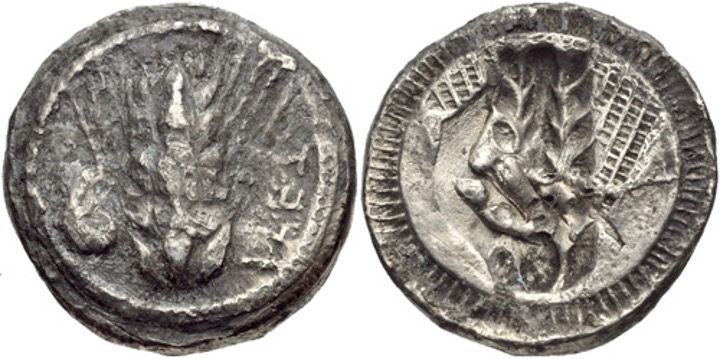

SO 1224 - Metapontum over Gela.jpg [1]
Location/history
| Sale(s)Sale(s) ᵖ: | UBS, 59, 29 Jan. 2004, 5166 (part of) = Classical Numismatic Group, EA 219, 30 Sept. 2009, 3. | |
| Private collection(s)Private collection(s) ᵖ: | C. E. Pitchfork Collection |
Overstriking coin
Description
| ObverseInscription or printing placed on the obverse.: | META (Greek) Ear of barley with five grains. In left field, ram’s head. Decorated border. | ReverseInscription or printing placed on the reverse.: | Incuse ear of barley with [six] grains. Border of rays (incuse). |
Mint and issuing power
| MintIdentifies the place of manufacture or issue of a numismatic object.: | Metapontum | Ancient regionAncient region. | Lucania | Modern countryModern country: Italy | AuthorityIdentifies the issuing power. The authority can be "pretended" when the name or the portrait of X is on the coin but he/she was not the issuing power. It can also be "uncertain" when there is no mention of X on the coin but he/she was the issuing power according to the historical sources: |
Chronology
| FromIdentifies the initial date in a range assigned in a numismatic context. 470 BCE toIdentifies the final date in a range assigned in a numismatic context.. 440 BCE | Archaic until 480 BC  periodTime period of the numismatic object. periodTime period of the numismatic object.
|
Physical description
| MetalThe physical material (usually metal) from which an object is made.: Silver
|
WeightWeight of the numismatic object (in grams). in grams: 7.317.31 g <br />7,310 mg <br /> | DenominationTerm indicating the value of a numismatic object. Examples: tetradrachm, chalkous, denarius.: nomos | AxisDescribes the directional relationship between the obverse and reverse of a numismatic object.: 1212 mm <br />1.2 cm <br /> |
| DiameterDescribes diameter of an object (in mm).: 2020 mm <br />2 cm <br /> | StandardStandard.: Achaian | ||
References
| Coin referenceReference of the Coin: | Coin series referenceReference to coin series study: | Noe 19271Noe 1927, n° 220, HN Italy2HN Italy, n° 1459, 1463, 1465, 1467, 1470, 1472, 1474, 1479, 1481-1486., HGC 13HGC 1, n° 1027-1029 | |
| Coin series web referenceCoin series web references: | |||
Overstruck type
Description
| ObverseInscription or printing placed on the obverse.: | ReverseInscription or printing placed on the reverse.: |
Mint and issuing power
| MintIdentifies the place of manufacture or issue of a numismatic object. ᵖ: | Ancient regionAncient region. ᵖ | Modern countryModern country: | AuthorityIdentifies the authority in whose name (explicitly or implicitly) a numismatic object was issued. ᵖ: |
Chronology
| FromIdentifies the initial date in a range assigned in a numismatic context. toIdentifies the final date in a range assigned in a numismatic context.. | Archaic until 480 BC periodTime period of the numismatic object.
|
Physical description
References
| Coin type referenceReference to coin series study ᵖ: |
Additional data
| Frequency of overstrikesFrequency of overstrikes: | frequent | Level of confidenceLevel of confidence of the identification: | |
| RemarksRemarks: | "area of undertype visible on reverse" (Bob Cutler: I think it was overstruck on a piece from Gela, with a weight reduction of roughly 10%) | ||
References
- ^ Noe, Sydney P. (1927), The coinage of Metapontum. Part 1, Numismatic Notes and Monographs 32, New York.
- ^ Rutter N. Keith et alii (eds.) (2001), Historia Numorum Italy, London, xvi, 223 p., 43 pl.
- ^ Hoover, Oliver D. (2018), The Handbook of Greek Coinage Series, Volume 1. Handbook of Coins of Italy and Magna Graecia, Sixth to First Centuries BC., Lancaster-London, 2018, lxi, 527 pages, 23 cm