100 BCE - 70 BCE- | ΔIONYΣOY ΣΩTHPΩΣ MAPΩNITΩN
Overstriking coin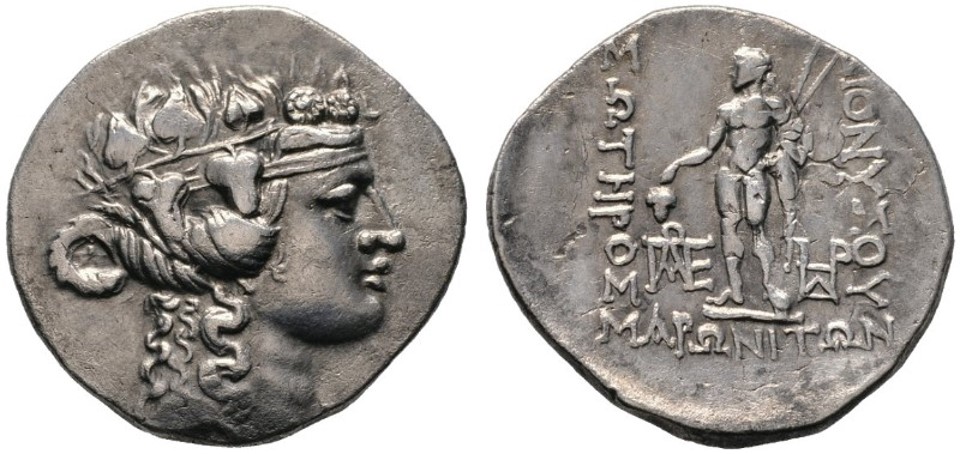
Maroneia on uncertain - Rauch, 6 Nov. 2015, E-Auction 18, 51.jpg
[1]
|
|
Sale(s)Sale(s) ᵖ:
|
Rauch, EA 18, 6 Nov. 2015, 51
|
|
|
|
Description
| ObverseInscription or printing placed on the obverse.:
|
| ReverseInscription or printing placed on the reverse.:
|
ΔIONYΣOY ΣΩTHPΩΣ MAPΩNITΩN (Greek) Dionysos standing half-left, holding grapes and narthex stalks, monograms to inner left and right
|
Mint and issuing power
| MintIdentifies the place of manufacture or issue of a numismatic object.:
|
Maroneia
|
Ancient regionAncient region.
|
Thrace
|
Modern countryModern country: Greece
|
AuthorityIdentifies the issuing power. The authority can be "pretended" when the name or the portrait of X is on the coin but he/she was not the issuing power. It can also be "uncertain" when there is no mention of X on the coin but he/she was the issuing power according to the historical sources:
|
Roman Republic
|
Chronology
| FromIdentifies the initial date in a range assigned in a numismatic context. 100 BCE toIdentifies the final date in a range assigned in a numismatic context.. 70 BCE
|
Hellenistic 323-30 BC  periodTime period of the numismatic object. periodTime period of the numismatic object.
|
Physical description
| MetalThe physical material (usually metal) from which an object is made.: Silver
|
WeightWeight of the numismatic object (in grams). in grams: 15.43g15,430 mg <br />
|
DenominationTerm indicating the value of a numismatic object. Examples: tetradrachm, chalkous, denarius.: tetradrachm
|
|
|
|
StandardStandard.: Attic
|
References
Description
| ObverseInscription or printing placed on the obverse.:
|
|
ReverseInscription or printing placed on the reverse.:
|
|
Mint and issuing power
| MintIdentifies the place of manufacture or issue of a numismatic object. ᵖ:
|
|
Ancient regionAncient region. ᵖ
|
|
Modern countryModern country:
|
AuthorityIdentifies the authority in whose name (explicitly or implicitly) a numismatic object was issued. ᵖ:
|
|
Chronology
| FromIdentifies the initial date in a range assigned in a numismatic context. toIdentifies the final date in a range assigned in a numismatic context..
|
Hellenistic 323-30 BC periodTime period of the numismatic object.
|
Physical description
| DenominationTerm indicating the value of a numismatic object. Examples: tetradrachm, chalkous, denarius. ᵖ:
|
tetradrachm
|
StandardStandard. ᵖ:
|
Attic
|
References
References
- ^ Schönert-Geiss, Edith (1987), Die Münzprägung von Maroneia, Griechische Münzwerk. Schriften zur Geschichte und Kultur der Antike 26, Berlin.
- ^ Hoover, Oliver D. (2017), Handbook of Coins of Macedon and Its Neighbors. 3. Part 2: Thrace, Skythia, and Taurike, Sixth to First Centuries BC, Lancaster-London, xix, 232 p.