10730 - Sardinia (uncertain Punic mint) (Lybian revolt) (AE Isis/three grains) over Sardinia (uncertain Punic mint) (Tanit/horse) (Carthago Nova seller, V coins, Nov. 2022)
From SILVER
241 BCE - 238 BCE
Images
Overstriking coin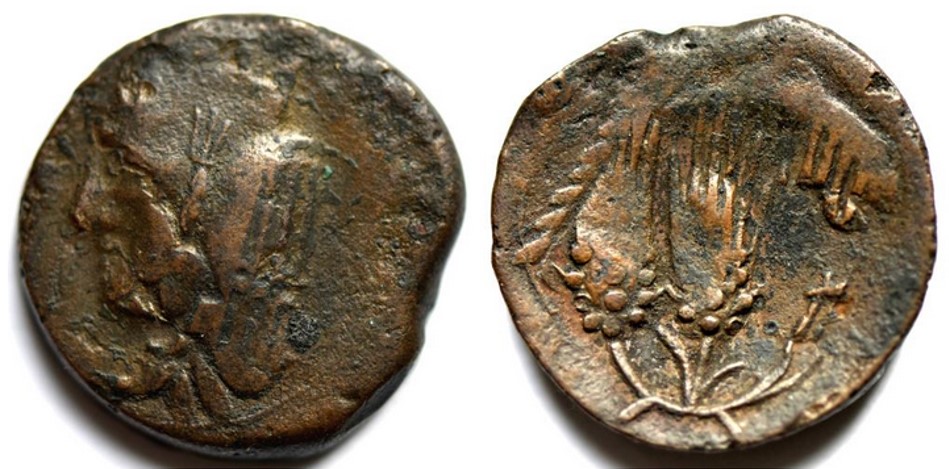
_over_Carthage_(Carthago_Nova_seller,_V_coins,_27_Nov._2022).jpg)
2300 - Carthage (bronze, 241-238 BCE) over Carthage (Carthago Nova seller, V coins, 27 Nov. 2022).jpg
Overstruck variety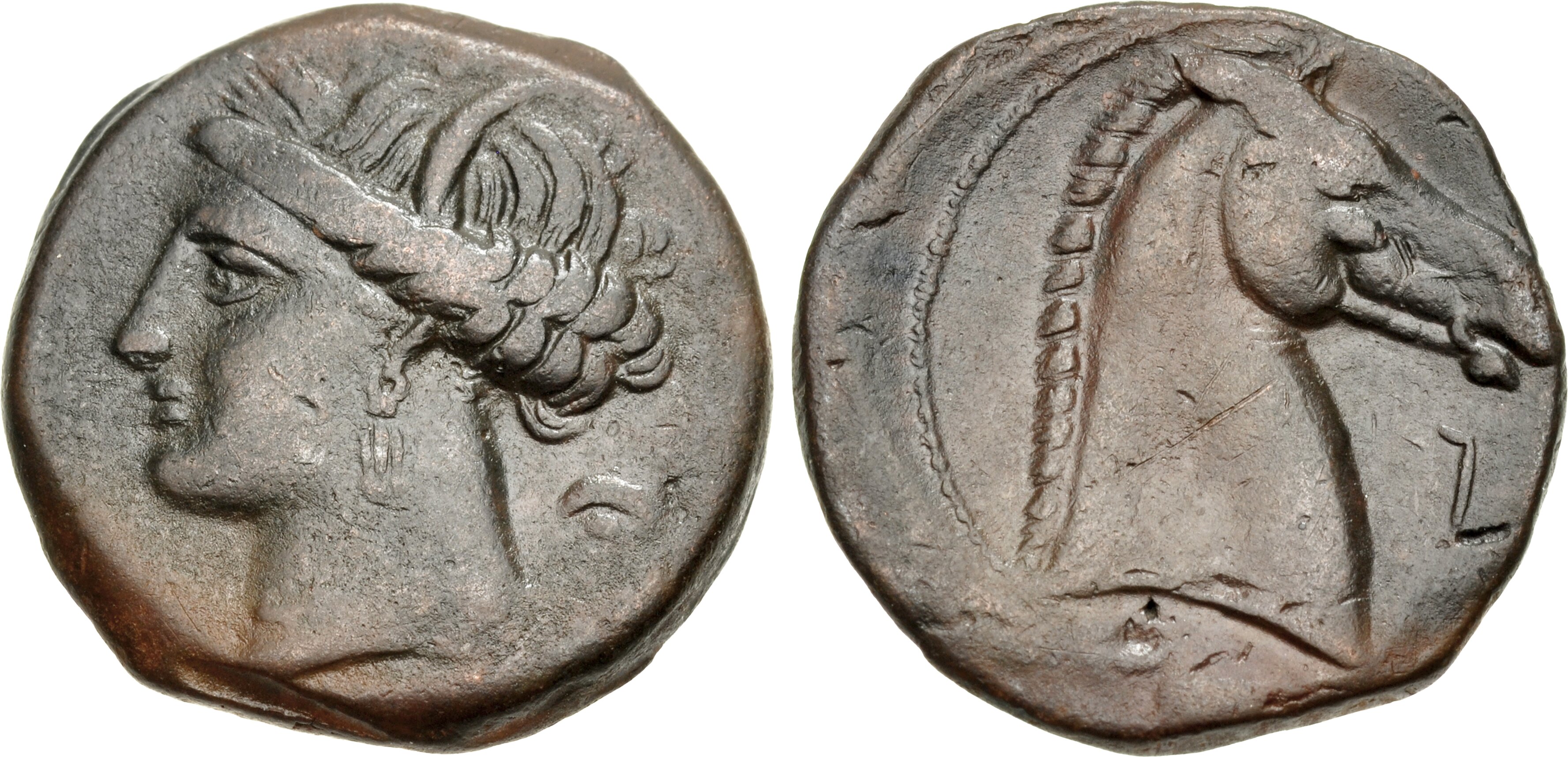

Carthage Tanit horse +.jpg [1]
Location/history
| Sale(s)Sale(s) ᵖ: | Carthago Nova seller, V coins, 27 Nov. 2022 | |
Overstriking coin
Description
| ObverseInscription or printing placed on the obverse.: | Head of Isis left | ReverseInscription or printing placed on the reverse.: | Three grain ears |
Mint and issuing power
| MintIdentifies the place of manufacture or issue of a numismatic object.: | Sardinia (uncertain Punic mint) | Ancient regionAncient region. | Sardinia | Modern countryModern country: Italy | AuthorityIdentifies the issuing power. The authority can be "pretended" when the name or the portrait of X is on the coin but he/she was not the issuing power. It can also be "uncertain" when there is no mention of X on the coin but he/she was the issuing power according to the historical sources: | Carthaginian Empire, Lybian mercenaries (241-237 BCE) |
Chronology
| FromIdentifies the initial date in a range assigned in a numismatic context. 241 BCE toIdentifies the final date in a range assigned in a numismatic context.. 238 BCE | Hellenistic 323-30 BC  periodTime period of the numismatic object. periodTime period of the numismatic object.
|
Physical description
| MetalThe physical material (usually metal) from which an object is made.: Bronze
|
WeightWeight of the numismatic object (in grams). in grams: 12.7012.7 g <br />12,700 mg <br /> | ||
| DiameterDescribes diameter of an object (in mm).: 2525 mm <br />2.5 cm <br /> | |||
References
| Coin referenceReference of the Coin: | Coin series referenceReference to coin series study: | SNG Copenhagen North Africa1SNG Copenhagen North Africa, n° 227, Alexandropoulos 20072Alexandropoulos 2007, n° 56, Viola 20103Viola 2010, n° 696e | |
| Coin series web referenceCoin series web references: | |||
Overstruck type
Description
| ObverseInscription or printing placed on the obverse.: | Head of Tanit to left, wearing wreath of grain ears, triple-pendant earring and elaborate necklace | ReverseInscription or printing placed on the reverse.: | Head of horse to right, to right, punic letter ' (ayin) |
Mint and issuing power
| MintIdentifies the place of manufacture or issue of a numismatic object. ᵖ: | Sardinia (uncertain Punic mint) | Ancient regionAncient region. ᵖ | Sardinia | Modern countryModern country: Italy | AuthorityIdentifies the authority in whose name (explicitly or implicitly) a numismatic object was issued. ᵖ: | Carthaginian Empire |
Chronology
| FromIdentifies the initial date in a range assigned in a numismatic context. 300 BCE toIdentifies the final date in a range assigned in a numismatic context.. 264 BCE | Hellenistic 323-30 BC periodTime period of the numismatic object.
|
Physical description
References
| Coin type referenceReference to coin series study ᵖ: | SNG Copenhagen North Africa1SNG Copenhagen North Africa, n° 151, Alexandropoulos 20072Alexandropoulos 2007, n° 57, HGC 24HGC 2, n° 1671 |
Additional data
| Frequency of overstrikesFrequency of overstrikes: | frequent | Level of confidenceLevel of confidence of the identification: | sure |
| RemarksRemarks: | "overstruck on horse's head type" | ||
References
- a b Jenkins, Gilbert Kenneth (1992), Sylloge Nummorum Graecorum: Royal Collection of Coins and Medals. Danish National Museum, volume 8. Egypt, North Africa, Spain, Gaul. Sunrise Publ., Inc.
- a b Alexandropoulos, Jacques (2007), Les monnaies de l'Afrique antique (400 av. J.-C.-40 ap. J.-C.), Presses universitaires du Mirail, Toulouse, 507 p., 17 pl.
- ^ Viola, Mauro R. (2010), Corpus Nummorum Punicorum, Numismatica Varesi, p.iv, p.960
- ^ Hoover, Oliver D. (2012), The Handbook of Greek Coinage Series. 2. Handbook of the Coins of Sicily (Including Lipara). Civic, Royal, Siculo-Punic, and Romano-Sicilian Issues. Sixth to First Centuries BC, Lancaster-London, 489 p.